




A West Gallery Evensong – a review
Sunday 19th October: 1800
We have had an appreciative letter from someone who attended our West Gallery Evensong on 19th October. A gentleman by the name of a Mr T Hardy – has been in conversation with someone who simply initialled a written account of their exchange with the initials ‘GPT’.

A Reminiscence of a West Gallery Evensong Held at St John’s Church, on the Nineteenth of October, in the Year of Our Lord Two Thousand and Twenty-Five, at Six of the Clock in the Evening
As Recounted by a Gentleman Long Familiar with the Place and Its People
It was upon a soft-hued Sunday eve, the sun long dipped beneath the rim of the downs and the hedgerows heavy with the last sigh of summer, that I found myself approaching the worn threshold of St John’s Church—a structure whose stones have known the passage of many centuries, and the prayers of many generations. The bell had tolled its summons with a tone more plaintive than commanding, and a curious hush lay upon the street as if even the town itself had paused to listen.
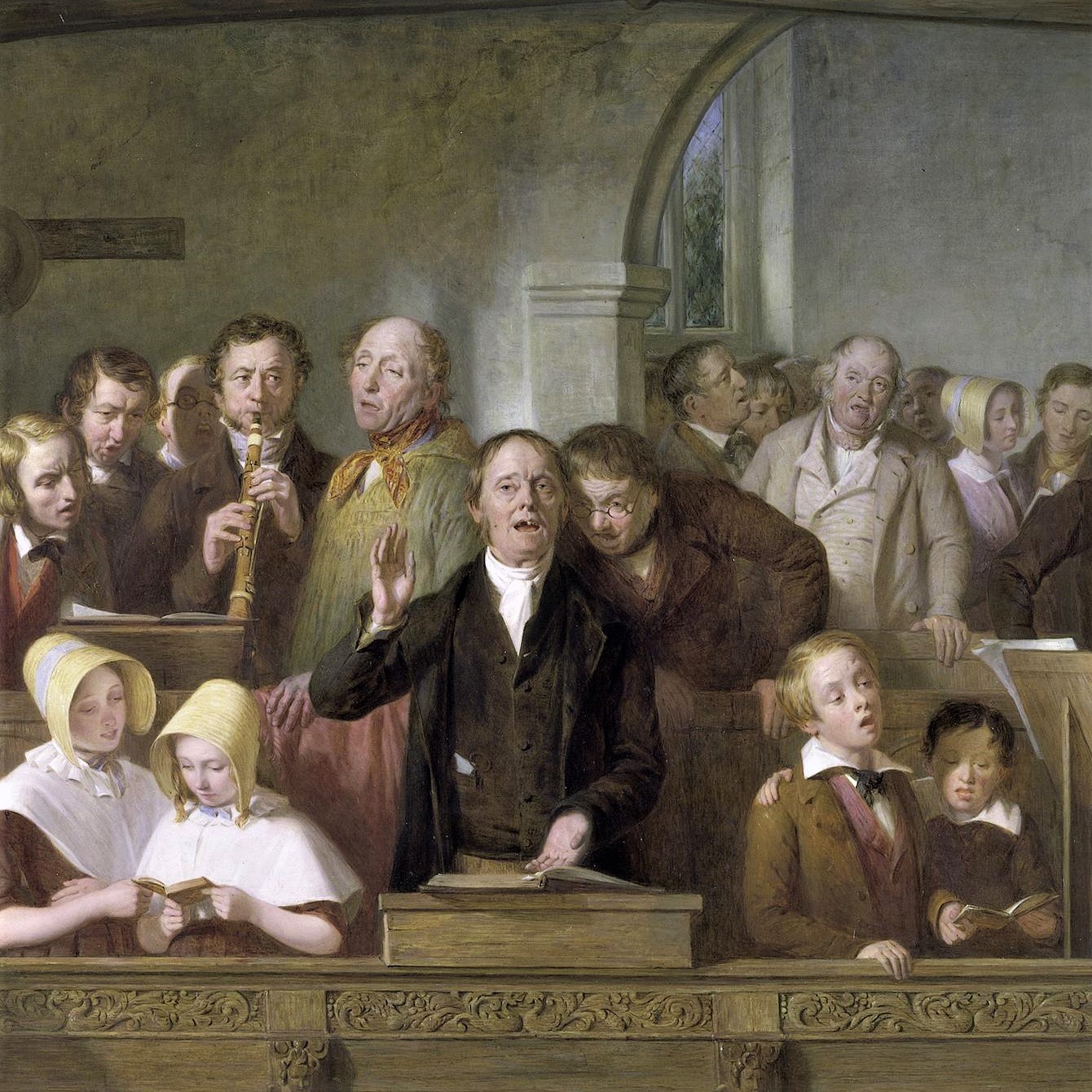
This service—unlike most in our age of dwindled fervour—was not one of rote ceremony or perfunctory devotion. No; it bore the singular distinction of being given over to that now seldom-heard mode of musical worship known as West Gallery. A form once prevalent in the chapels and naves of rustic England, yet now relegated to memory, and to the yellowed pages of disused hymnals.
Canon Judy Anderson presided with a manner both dignified and unpretentious, her words bearing the cadence of one who has lived amongst her flock, rather than above them. In her introduction she spoke of the West Gallery tradition. It was, she said, a music born of village choirs and chapel fiddlers, of bass viols and serpents, of human voices raised not with polished precision but with fervour and conviction. One almost imagined the ghostly strains of such instruments rising again from the vanished gallery—now no more than a shadowed space above the nave, boarded over and forgotten by all but time.
The music began—not with the thin, reedy timbre of an electric organ, nor the solemn austerity of plainsong, but with a sound altogether more robust and rooted. There was a genial disorder to it, a rough harmony that seemed to echo the unlevel furrows of a ploughed field, or the jostle of cartwheels along a rutted lane. And yet—within that irregularity—there was a strange beauty. The notes, though not always refined, were honest; the rhythm, though occasionally unruly, bore the stamp of human labour and joy.
The Psalm resounded through the stone vaults like a wind rushing through the beeches; and the Magnificat, set in a style more fit for a country fair than a cathedral, seemed to lift the very roofbeams. One might have imagined it sung by a gathering of labourers and maidens upon some remote upland, their breath visible in the chill dusk, their voices warmed by cider and common purpose.
Of particular note was the hymn, Be Thou My Guardian and My Guide, rendered with such force and feeling that one felt it no longer a familiar melody but a living plea—a supplication borne aloft not on angelic wings, but on the shoulders of common folk who knew both toil and grace.
As the last chord faded into the crevices of the church, and the congregation emerged once more into the night— I felt a peculiar ache. It was the ache of things passing: of traditions nearly lost, of songs nearly silenced. And yet, too, there was solace—in the fact that, for one evening at least, such music had stirred again, and found welcome.
It is to be hoped that this evensong, rustic in its harmonies yet solemn in its intent, shall not be a solitary occasion. For there is something in the West Gallery style—boisterous though it be—which touches the deep chord of English spiritual life, rooted as it is in hedgerow and hearth, in plough and pew.
In sum, it was an evening both grave and gladsome. And if you should find yourself invited to such a service in time to come, be not deterred by modern misgivings. Go—and you shall hear the heart of a vanished England singing still.
